Rail line wins Länsimetro’s first Co-operation Award

The new award is given to Länsimetro’s worksites twice a year as a testament to co-operation skills. In a construction project of the West Metro’s magnitude, co-operation and interaction between the various players is highlighted.

The Co-operation Award is Länsimetro’s own perpetual trophy that is awarded twice a year to a winner selected from its own active worksites. The first winner of the award is the rail line worksite, which is building seven kilometres of rail line, seven shafts and 32 connecting tunnels along the Matinkylä–Kivenlahti section. Learn more about the rail line

“A construction project of the West Metro’s magnitude highlights co-operation and interaction between the various players. We want to measure co-operation and trust in every construction contract and address potential obstacles to co-operation as early as possible before they pose problems for the progress of the project,” says Jaakko Naamanka, Project Manager on the Matinkylä–Kivenlahti project.

Common spaces ensure good communication and reinforce team spirit

The award is given twice a year to a winner selected from Länsimetro’s own active worksites. The objective is to continuously improve co-operation and trust. Länsimetro measures the smoothness of co-operation on its worksites four times a year using a questionnaire that is integrated in the project management model. Measurements have been made since June 2018 as the construction contracts have started up. All parties involved in the construction answer the questionnaire. The respondents give a numerical grade, as well as open-ended comments on various themes. The Celkee Insight service is used for the measurement, which provides information on communication, co-operation, trust and professional pride. The criteria for the award are, in addition to the average score given to the themes in the survey, the positive development of the worksite’s results, the response rate for each respondent group and the number of comments.

The rail line’s average score for the themes measured in the questionnaire was high. Communication and co-operation in the rail line project have developed positively throughout the measurement period. In addition, the rail line’s respondents were eager to comment. The response rate for the rail line was relatively good, at 60%.

“Our worksites follow a genuine Big Room approach: we work together in shared spaces. Communication flows better without unnecessary doors, and email discussions can be avoided simply by taking a few steps to talk to someone. When information flows, it’s easier to aim for the same target,” says Construction Manager Jenni Matikka, offering an example of good co-operation practices on a worksite.

Read more

First environmental statement for Länsimetro’s Matinkylä–Kivenlahti project completed

In an environmental statement on the Matinkylä–Kivenlahti project, Länsimetro has determined the environmental impacts of the excavation and construction of the metro tunnels and five metro stations (Finnoo, Kaitaa, Soukka, Espoonlahti, Kivenlahti), as well as the Sammalvuori depot, in 2014–2019.

To assess environmental impacts, we monitor the impacts of construction on the groundwater, ground settling, water level and soil, and we monitor water consumption and wastewater processing during construction, taking biodiversity into account and paying attention to dust and noise caused by the work sites.

The excavation contracts started up in 2014 and ended in 2018. Construction of the metro continued with construction contracts covering the stations and the rail tunnel, and these will continue until 2023.

The following is reported on in the environmental statement covering the 2014–2019 excavation and construction phase:

  • Consumption of main materials: explosives, chemicals, fuels, concrete
  • Energy consumption
  • Carbon footprint
  • Generation and utilisation of aggregates
  • Generation and processing of waste
  • Impacts on groundwater, ground settling, water level and soil
  • Water consumption and wastewater
  • Biodiversity
  • Dust
  • Noise
  • Stakeholders and dialogue, feedback, environmental requirements

As the developer, Länsimetro encourages material efficiency

Länsimetro, as the developer, can have an influence by encouraging contractors to be efficient in their use of materials. Material efficiency in construction saves natural resources and reduces waste, in turn, also mitigating the construction site’s carbon dioxide emissions. Some examples are using data modelling when designing the station and careful planning of the work phases and material purchases, which helps avoid ordering excess materials and storing them on the work site.

Construction volumes are reflected in, for instance, the number of rock-reinforcing bolts used during the excavation phase. Tunnels are reinforced at the stations using roughly six-metre-long bolts that are drilled into the rock. Based on the excavation contractors’ information, an average of 100 km of rock-reinforcing bolts were installed in the stations per excavation contract. With the average length of one bolt being six metres, the total length corresponds roughly to the distance between Helsinki’s main railway station and Hämeenlinna’s city centre.

The environmental statement also contains an assessment of the environmental impacts of blast-rock haulage. The total haulage distance for all the two-way haulages in the station and tunnel excavation contracts amounts to approximately 10,664,900 kilometres. This is the equivalent of around 267 times around the world.

72% of the carbon footprint comes from construction materials

The environmental statement also reveals that by the end of 2019, the majority (72%) of the carbon footprint of the entire Matinkylä–Kivenlahti project was made up of materials, followed by rock-blast and waste haulage (13%) and fuels (9%). By the end of 2019, roughly half of the entire project’s carbon footprint arose during the excavation phase and half during the construction phase. The total carbon dioxide emissions from excavation and construction amounted to 90,800 tCO2 by the end of 2019.

Groundwater monitored, flying squirrels taken into account

The findings of the environmental statement also indicate that the project’s construction work has had no noticeable impact on the quality of water in the groundwater pipes. In many places, the changes in the ground-settling monitoring points of buildings remained below the measurement inaccuracy. No changes deviating from the natural situation have been observed in the water level of Hannusjärvi Lake.

Near the rail line, the Finnoo area, the Kaitaa area and the Espoonlahti–Soukka area have been identified as core flying squirrel habitat areas. The core flying squirrel areas have been taken into account in the metro station planning, and flying squirrel habitats have not been endangered. The area’s metro shafts have been situated to cause as little disturbance as possible to flying squirrel habitats. The main routes of flying squirrels, i.e. treetop connections, have been retained.

Stakeholders a key part of the project

Stakeholder work has been and continues to be an important part of the Matinkylä–Kivenlahti project. The most important stakeholders from an environmental sustainability perspective are the construction area’s nearby residents, businesses and other operators, builders, policy-makers and the owner, the authorities and the personnel working on the project.

Feedback on the Matinkylä–Kivenlahti project can be given by phone or via the feedback form on the website. All feedback is addressed and responded to. Measures have been taken based on the feedback, for instance, possible damage has been investigated, the cleaning of work-site roads has been stepped up, and direction has been given to work-site operations as required based on noise complaints.

The environmental statement will be updated in 2020–2023.

Read the environmental statement (in Finnish, PDF )

Further information:

Kati Vesikallio, Environmental Manager, email kati.vesikallio(at)lansimetro.fi

West Metro stations win Lighting Design of the Year for 2019

Länsimetro’s metro stations have been awarded for their lighting for the third time now. In addition to winning the title of Lighting Design of the Year for 2019, the eight metro stations of phase II also received two other esteemed international awards – Lighting Design Awards: Highly Commended, and LIT Awards: Winner

Tapiolan asema
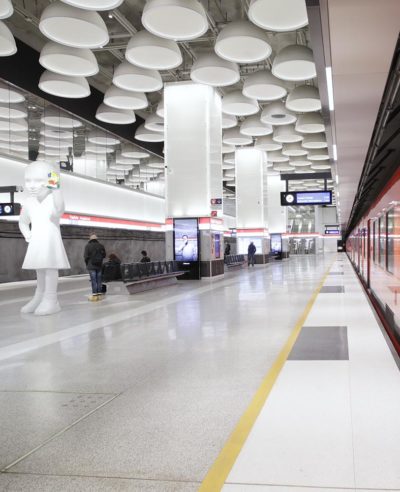
The Tapiola metro station is a prime example of the smooth integration of light and architecture. 

The West Metro stations won in the interior illumination category of the Lighting Design of 2019 competition.

The lighting in the public spaces of the eight metro stations that are part of phase I of the West Metro (i.e. Lauttasaari, Koivusaari, Keilaniemi, Aalto University, Urheilupuisto, Niittykumpu and Matinkylä) was designed by VALOA design. The overall architectural integration was headed by CJN Architects, and the architecture of the stations was designed by Helin & Co, ALA Architects + Esa Piironen, APRT Architects and HKP Architects. The electrical engineering was executed by Tauno Nissinen Ltd., and the electrical contractor was Are. The light art for the stations was provided by Tommi Grönlund and Petteri Nissinen (Keilaniemi station), and Lighting Design Collective and Helin & Co (Lauttasaari station).

Architecture, art and design create the metro stations’ identity

The competition assesses, among other things, the intended use of the site and lighting that supports the overall architectural solution. The aim for the lighting was to enhance commuters’ enjoyment of the spaces, and to fit in seamlessly with their surroundings.

“The key of the West Metro stations’ lighting solution is the integration of light and architecture as a coherent entirety. Each station has its own identity which is formed from the combination of architecture, art, and light. The role of lighting has been considered diversely, and the solution is subdued, but also architecturally high-quality and functioning in commuters’ everyday lives. The high-quality visual impact is created by the repetitive lighting styles, non-glare, sufficient light levels and the integration of the lighting,” says VALOA design’s CEO Roope Siiroinen, who was the lighting designer for the metro stations.

“The architectural lighting solutions used in the Helsinki metro stations are a refreshing exception to the usual metro station lighting. The high-quality environment makes passengers feel that the design not only aims for functionality, but also to increase their comfort,” said the jury on its selection of West Metro as the 2019 winner in the interior illumination category.

In granting the awards, compliance with the requirements set for modern lighting technology and the creative application of technical solutions, as well as financial and ecological factors, were also taken into account. Read more about the 2019 Lighting Design competition. (in Finnish)

The winners were announced on Wednesday, 5 February, at the Sähkö Valo Tele AV exhibition in Jyväskylä. As a competition winner, the West Metro’s lighting will take part in the Nordic Lighting Design Awards competition. The Finnish Lighting Awards competition is organised by the Illuminating Engineering Society (IES) of Finland once every two years, and awards are given for both interior and exterior lighting. The competition shines a spotlight on Finnish lighting designers and developers and commendably realised lighting projects.

Read about all of the West Metro stations.

Koivusaari metro station’s platform-level floor to be re-laid – station will be closed in the summer

The Koivusaari metro station’s floor will be re-laid at the platform level in summer 2020 due to cracks in the mosaic concrete. Although the cracks do not affect the usability of the station, it was decided that the repairs should be completed as soon as possible. For that reason, the surface structures of the platform-level floor will be re-laid between 1 June and 5 August 2020.

In order to ensure that the floor can be completed over as brief a period as possible, the Koivusaari station will be closed while the work is carried out. This also means that disruptions caused by the work site will be concentrated in the summer season, when commuter volumes are the lowest.

We apologise for any inconvenience caused to commuters. The repair work will be carried out efficiently and safely such that the metro traffic passing through the station will not be disrupted, and the duration of the work will be as short as possible. The work will be carried out in three shifts. The station’s elevators and entrance lobby will be reserved for the work site personnel during the repair work. While the work is carried out, frequent metro traffic will run on both sides of the work site. The smooth flow of metro traffic was taken into account when the repair work was planned.

In 2019, the Koivusaari metro station had an average of 2,100 commuters per weekday. In July 2019, the average number of commuters was roughly 1,500 per weekday. Commuter volumes were smaller on weekends, both in summer and winter. The next metro station, Lauttasaari, had an average of 12,200 commuters per weekday, and for July that figure was 9,200.

During the floor repairs, HSL will provide additional bus transportation from the Katajaharju and Isokaari areas to the Lauttasaari metro station. Bus line 104, which travels from Lauttasaari metro station along Lauttasaarentie to Haukilahti, also serves commuters in the area. In Espoo’s Hanasaari, buses will run along Länsiväylä during rush hour periods also in the summertime. HSL will provide more information on the alternative connections during the spring on the website hsl.fi/koivusaari2020, and the information will be available in Reittiopas at a later date.

The Koivusaari metro station was completed in 2016 and opened to the public in November 2017.

Further information:

Länsimetro’s feedback telephone  (mon–fri  9 am–3 pm.): 050 377 3700

HSL (Helsinki Region Transport): traffic arrangements and commuter information: hsl.fi/koivusaari2020

Water damage at Keilaniemi metro station on 31 January – no impact on metro traffic

The technical facilities of the Keilaniemi metro station experienced water damage between Thursday night and Friday morning. HKL’s control room received an alert from Länsimetro’s system at 11.53 p.m. The fire and rescue department was called to the scene at 20 minutes past midnight. Water overflowed from the sprinkler reservoir and reached the lower floors of the station.

The water damage did not affect morning metro traffic. As metro traffic began, all of the station’s escalators were also working normally. However, two elevators at the north entrance are still out of order. They will be up and running again once the area surrounding the elevators has been dried.

The reason for the water damage will be investigated.

Länsimetro’s feedback line (Mon–Fri, 9 am to 3 pm): +358 (0)50 377 3700.

Summary of Länsimetro’s meeting of the Board of Directors on 22 January 2020

The CEO presented to the Board of Directors the 2019 status report and annual report on the ownership of the Ruoholahti–Matinkylä section owned by Länsimetro Oy. Key events included: The Länsimetro Oy – HKL cooperation agreement was signed in accordance with the renewed financial model on 27 November 2019, a new information management system was developed and introduced in 2019 and the modernisation of the electronic maintenance log was begun. The southern entrance of the Tapiola station was completed and opened to the public in April 2019, the bomb shelter for the Matinkylä station’s service tunnel was completed and received a commissioning permit at the turn of 2019/2020, the wall structures directing air flow in the Matinkylä station’s eastern escalator lobby were completed in spring 2019, the frame of Matinkylä station’s western entrance was completed in autumn 2019 and moved on to the decoration phase (estimated completion during 2020), the alteration work on the eastern stair connection at the Urheilupuisto station (changing an emergency exit into an entrance) is expected to be completed in February 2020.

The Board was presented the Q4 ownership risk report and annual summary.

The CEO presented the monitoring of administrative and maintenance performance carried out by HKL on the Ruoholahti–Matinkylä section of the West Metro. No traffic disturbances resulted from the West Metro’s infrastructure. HKL not only operates the metro traffic but also reports to Länsimetro Oy on the use of the metro line and the stations and the related servicing and maintenance tasks as agreed.

The Board was presented with the annual review for 2019 for the Matinkylä-Kivenlahti section under construction and the key focal areas for 2020. Key events in 2019 were: The construction of the frame structures of the stations and rail line has proceeded according to schedule, the HVAC and electricity work at the stations and on the rail line started up at all the sites, subcontract work started up, procurements were completed, the number of employees at the worksites exceeded 1,000 (now 1,174 persons) and the construction work at the Sammalvuori depot was completed during 2019. As a whole, construction of the Matinkylä–Kivenlahti section is progressing in line with the project plan’s schedule and budget. Read more about the construction schedule and phases.

In 2020, the focus of construction will be on technical systems, the commencement of rail technology contracts, the starting of the commissioning of the Sammalvuori depot and completion of the depot, an increase in the number of worksite employees and the continued focus by Länsimetro Oy, as a responsible developer, on occupational safety. During 2020, the commissioning phase planning will be finalised and further efforts will be made to improve the quality of internal communications and the flow of information.

A risk management report on the construction of the Matinkylä–Kivenlahti section was presented to the Board.

Länsimetro Oy’s management and owner organisation’s personnel survey was presented to the Board. The aim was to look into the personnel’s coping at work and work motivation, the clarity of their job descriptions and tasks and their perceptions concerning the organisation’s functioning and its leadership practices.

The next meeting of the Board of Directors will be held on 27 February 2020.

Further information:
Olli Isotalo, Chairman of the Board of Länsimetro Oy, tel. +358 (0)50 593 3359
Ville Saksi, CEO, Länsimetro Oy, tel. +358 (0)40 823 2086
Media contacts: Satu Linkola, Communications Director, tel. +358 (0)46 877 3392